Lutheran Faith and Worship
Hymns and Liturgical Music
Why Lutherans sing at every service, how a hymnal such as Evangelical Lutheran Worship works, and what a choir adds to a Sunday.
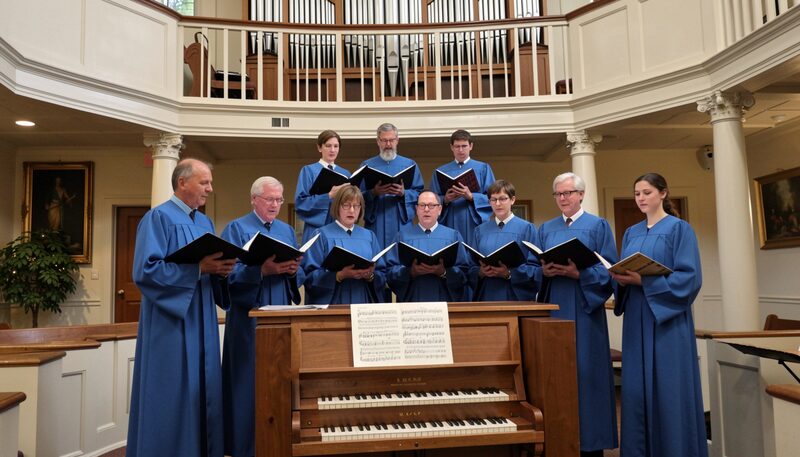
Ask a Lutheran what holds the service together and the answer, after theology, is usually singing. The tradition has been called the singing church, and the nickname is earned: the assembly sings at the opening, at the psalm, at the gospel, at the table, at the dismissal, and often on the way to coffee. Martin Luther himself wrote hymns, played the lute and insisted that music stood next to theology in the life of a Christian, and his conviction settled into the architecture of Lutheran worship for five centuries. This article explains how the singing works, from the hymnal in the rack to the choir loft, and why a visitor will not sit through a Lutheran service as an audience.
Why do Lutherans sing so much?
The singing is theological before it is musical. If the liturgy is the work of the people, then the congregation's own voice is the principal instrument of the service, not the organ, not the choir. Lutherans sing the ordinary parts of the service, the kyrie, the hymn of praise, the sanctus, the agnus dei, because these are the assembly's lines in a drama that belongs to everyone. Hymns carry doctrine as well: the first Lutheran hymnals of the 1520s were deliberately published so that ordinary people could sing their way into the gospel, at home during the week and in church on Sunday. A tradition that hands the melody to the room, not to a soloist, has decided something about who the service belongs to.
How does a hymnal actually work?
The book in the pew rack has two halves, and knowing that saves a visitor real confusion. The front of the hymnal holds the liturgical settings, the spoken and sung orders for communion, baptism, marriage and burial, plus psalms and prayers. The back holds the hymns themselves, numbered in the thousands in current books. The standard book in Evangelical Lutheran Church in America congregations is Evangelical Lutheran Worship, published in 2006, usually shortened to ELW, which succeeded the Lutheran Book of Worship of 1978. Many Macon-area congregations keep both in the racks, and some keep their predecessors beside them, which is why the folder prints both page and hymn numbers. Congregations of other traditions use different books with the same inner logic, Baptist and Methodist hymnals among them, so the two-halves habit travels well across the city.
What is a liturgical setting?
A setting is a composed package of music for the assembly's sung lines. The same words, kyrie eleison, glory to God, holy holy holy, lamb of God, come with several tunes in the hymnal, each numbered as a setting. A congregation picks one setting, lives inside it until the assembly knows it without thinking, and moves to another with the season or the year. The point is repetition with variation: the words stay stable, the music breathes differently. When a congregation in Middle Georgia learns a new setting over a few Advent weeks, the grumbling in the pews is real, and so is the moment two months later when the room sings the new setting without looking up. That moment is what music directors call ownership, and it is the whole game.
Which hymns does the room actually know?
The core repertoire crosses centuries and languages. A mighty fortress is our God, Luther's own paraphrase of Psalm 46, functions as the tradition's unofficial anthem. Now thank we all our God, Beautiful Savior, Praise to the Lord the Almighty and Joyful joyful we adore thee are sung in Lutheran, Methodist and Presbyterian rooms alike, which means a visitor from any hymn-singing congregation arrives already knowing half the playlist. Hymns are chosen each week to match the lectionary readings and the season, a quiet craft that musicians plan months ahead; the pastor and the organist usually meet weekly to match tune, text and Sunday. In Lent the hymns darken and slow, in Easter they open wide, and on a festival Sunday a Macon congregation with a trumpeter will use the trumpeter.
What do the choir and the organ add?
The choir in a typical congregation is a volunteer crew of eight to twenty, rehearsing one evening a week, and its main job is leadership before it is performance: the choir teaches the assembly its lines and holds the room together when the setting changes. The anthem, usually sung while the offering is gathered, is the moment the choir speaks alone, and repertoire ranges from Bach motets in big-city parishes to gospel-flavored arrangements and Taizé refrains in others. The organ, where the building has one, is the leadership instrument, loud enough to carry a hesitant room and gentle enough to disappear under confident singing. Smaller congregations make do with a piano or a guitar pair, and the theology does not change with the instrument; theologically informed readers will note that the tradition has survived everything from pipe organs to tambourines without losing its arguments.
What did Bach inherit from the pews?
Johann Sebastian Bach spent his working life as a Lutheran church musician in Germany, writing cantatas week by week for the same lectionary that Lutheran congregations still read, and his music remains the tradition's most exported product. The inheritance runs both ways: Bach's chorale settings grew out of congregational hymns, and congregational hymns still show up in his arrangements. Middle Georgia hearers meet this repertoire most often in Lent and Holy Week, when choirs program passions and cantatas, and at Christmas, when the descants on carols turn out to be his colleagues' work. A reader who wants the full architecture of the tradition's belief can move from here to what Lutherans believe, where the sacraments those cantatas celebrate are set out plainly.
Where does the music reach past Sunday?
Church music in a congregation has weekday tentacles. Children's choirs and handbell choirs rehearse after school, Christmas programs recruit every child in the Sunday school, and the article on children and family ministries describes what those programs do for families beyond the music itself. Midweek services in Lent sometimes run as hymn-sermon series, where the pastor preaches on one hymn verse per week and the congregation sings the verse afterward, a format older than the projector screen and more durable. Summer brings vacation Bible school songs, complete with hand motions, to the delight of children and the patient endurance of parents, and those melodies return uninvited for decades.
Where can Macon hear sacred music?
The city listens well. Around the holidays, choral concerts and seasonal services open historic sanctuaries to the public, and college and community choirs program sacred repertoire in churches precisely because the buildings were built for it. A congregation's own choir festival or hymn sing, advertised on a sign board, is usually free, open and under an hour, which makes it one of the best low-commitment ways to hear a congregation's inner life before visiting a service described in the order of a Lutheran service. The standing rule for sacred-music events in Macon is the rule for the whole tradition: arrive, sit, listen, and let the room carry you.
Read next
Lutheran Faith and Worship
Lutheran Faith and Worship
What Lutherans believe, how a Sunday service runs, the hymns that carry the tradition, and how to read a Macon congregation's history.
Belief, the order of a service, the hymns, and a congregation's records.
Lutheran Faith and Worship
What Lutherans Believe
A plain introduction to Lutheran belief: grace alone, faith alone, scripture, baptism and holy communion in the Small Catechism.
Grace alone, faith alone, scripture alone, in plain words.

Congregation and Family Life
Children and Family Ministries
What church programs offer families: Sunday school, children's music, youth groups and seasons such as vacation Bible school.
Sunday school, children's music, youth groups and vacation Bible school.